Our Warehouse Management System Development Services
From greenfield WMS builds to legacy system migration and multi-site platform development complete WMS development capability.
.webp)
Encrypted InfoWeb builds custom warehouse management system software for manufacturers, distributors, 3PLs, ecommerce fulfilment centres, and enterprise logistics operations that need real-time inventory visibility, optimised picking workflows, and seamless ERP integration not a generic WMS that requires your operations to fit its assumptions. Serving clients across the United States, United Kingdom, Germany, Australia, and the UAE.
Book Free Consultation

10+ Years
Experience in digital delivery

200+ Projects
Across web, apps & software

Global Client Coverage
Global delivery & collaboration

NDA Ready
Confidential, IP-aware workflows
A Warehouse Management System (WMS) is software that controls and optimises warehouse operations from goods receipt and putaway to picking, packing, and dispatch. A custom WMS integrates with barcode scanners, RFID readers, ERP systems, and carrier APIs to provide real-time inventory visibility and operational efficiency across one or multiple warehouse locations without the limitations of generic off-the-shelf platforms.
These are the operational problems we are called in to fix most often. If any look familiar, a custom WMS addresses them directly.
When your ERP shows 400 units in stock but your team can only find 310, the discrepancy accumulates through every failed pick, every manual adjustment, and every customer delivery that ships short. A WMS with real-time scan-confirmed movements closes this gap at the transaction level.
Manual paper-based pick lists produce errors at a rate that barcoded, scan-to-confirm picking eliminates almost entirely. A WMS that validates every pick against the order before packing brings mispick rates to near-zero and the customer complaint volume that follows them down with it.
Managing inventory across multiple warehouses, fulfilment centres, or 3PL locations in different countries without a consolidated WMS means someone is manually reconciling spreadsheets to produce stock positions that are already out of date. A multi-site WMS provides a unified live view across all locations.
Off-the-shelf WMS platforms define warehouse zones, aisle structures, and bin types based on their own data model. If your warehouse has non-standard storage configurations high-bay racking, ambient and cold zones, hazmat bays you spend years working around a system that never quite fits.
An unoptimised pick path in a large warehouse costs minutes per order. Across hundreds of orders per day, that time compounds into missed carrier collection windows and customer delivery promises. Directed putaway and optimised pick routing, built around your warehouse's physical layout, directly reduces order completion time.
When your ERP and WMS do not communicate in real time, every goods receipt, stock adjustment, and dispatch requires manual double-entry or a batch overnight sync that leaves both systems out of date throughout the working day. Custom WMS development integrates these systems at the API level.
Here is who we work with most effectively and what each type of operation gains from a purpose-built WMS.
Raw material receipt, component kitting, finished goods storage, and despatch management connected to your production ERP in real time. Custom WMS for manufacturers handles the nuances of batch tracking, expiry date management, and production floor stock transfers that generic platforms approximate.
Multi-client inventory segregation, client-specific SLAs, billing by storage location, and client portal access are all requirements that off-the-shelf WMS platforms charge significant premium add-on fees to support. A custom 3PL WMS builds all of this in from the data model level not as bolt-on modules.
High-velocity B2C order picking with tight carrier cut-off windows, returns processing, and multi-channel order source management (Shopify, Amazon, B2B portal). A custom ecommerce WMS is built around your daily order volume, your SKU count, and your specific carrier integrations not a configuration of a platform designed for warehouse operations three times your scale.
Cold chain tracking, hazardous materials bay management, pharmaceutical batch/lot traceability, and serialised product tracking are compliance requirements that standard WMS platforms handle inconsistently. Custom WMS for regulated storage industries in the UK, Germany, and UAE is built with the compliance data model embedded from day one.
From greenfield WMS builds to legacy system migration and multi-site platform development complete WMS development capability.

We design and build bespoke WMS software from scratch mapping your warehouse zones, bin locations, product types, and workflow sequences into a system that operates the way your warehouse actually works. Goods receipt with scan validation, directed putaway logic, optimised pick routing, packing station management, and despatch with carrier label generation are all built to your operational specifications. See our web development services for full technical scope.

A WMS is only as accurate as its data capture hardware. We integrate custom WMS software with handheld barcode scanners (Zebra, Honeywell), mobile devices, fixed scanners at conveyors and dock doors, and RFID readers for high-velocity or hands-free environments. Every scan event is validated in real time against the WMS database confirming the right product, the right quantity, and the right location before the movement is committed. Connects to our Node.js API development.

A WMS that does not communicate with your ERP in real time creates the same manual reconciliation problem you are trying to solve. We build bi-directional integrations between the custom WMS and your ERP (SAP, Oracle, Microsoft Dynamics, or a custom system), carrier APIs (DHL, UPS, FedEx, Royal Mail, DPD), and ecommerce platforms (Shopify, Magento, Amazon). Stock adjustments, order status, and despatch confirmations flow automatically no manual double-entry. See our custom ERP development services.
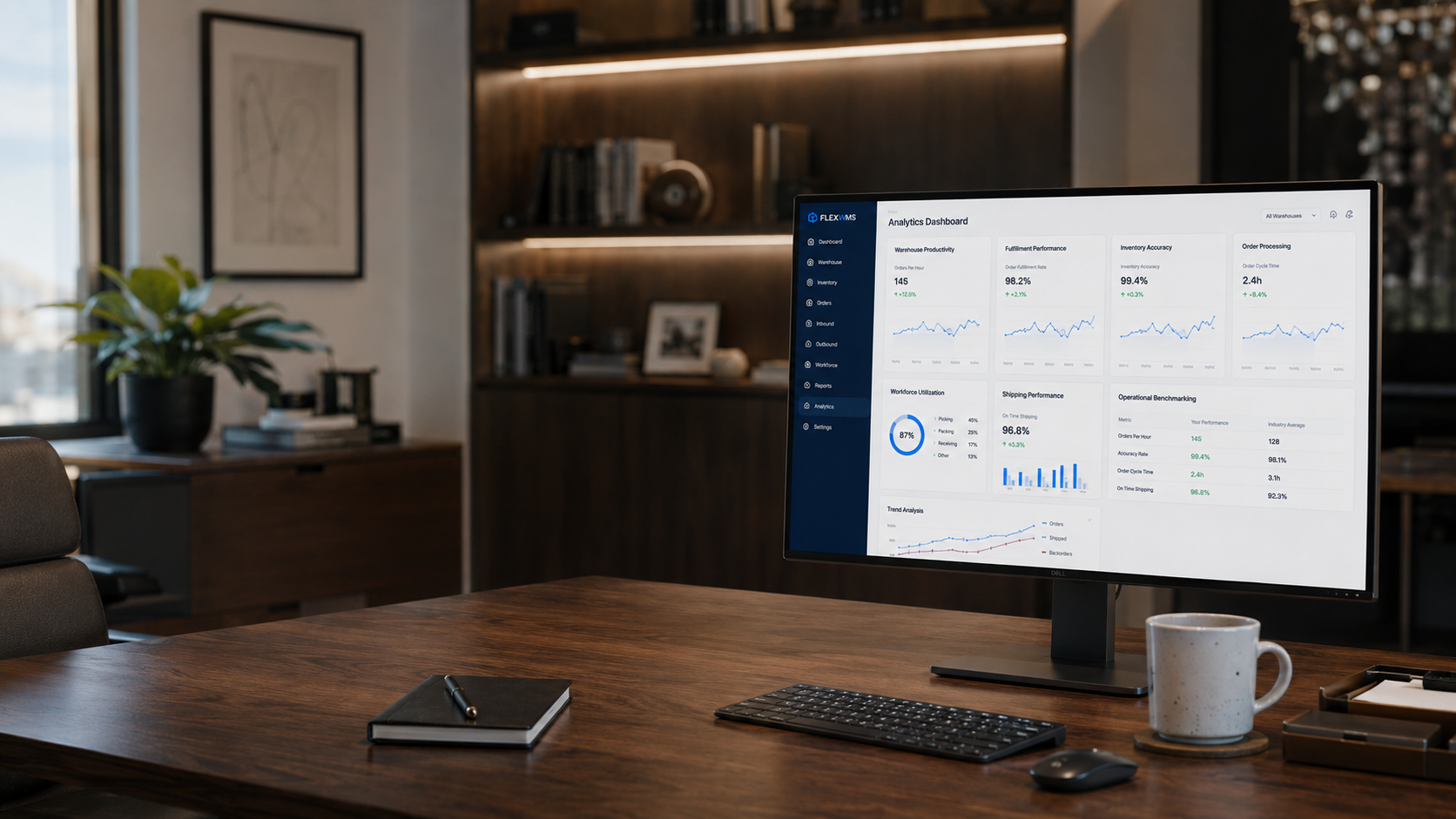
Warehouse managers, operations directors, and client accounts (for 3PLs) need different views of the same warehouse data. We build role-based WMS dashboards that surface real-time KPIs picks per hour, dock-to-stock time, order cut-off performance, inventory turn, and space utilisation alongside scheduled performance reports that replace manually assembled spreadsheets. See our frontend development services for dashboard UI and our UI/UX design services for enterprise interface design.

Managing inventory across multiple warehouse locations whether owned, leased, or 3PL-operated from a single platform requires a data architecture that maintains site isolation while providing consolidated group-level visibility. We architect cloud-based WMS platforms on AWS or Azure with multi-site support, configurable per-site workflows, consolidated reporting, and the data residency options that German (DSGVO) and UK (GDPR) operations require when data sovereignty is a compliance consideration. Connects to our cloud infrastructure services.
A structured, milestone-based process from warehouse operations audit to go-live with working system modules at every stage.
We document your warehouse layout, movement flows, system gaps, hardware, and ERP requirements under a signed NDA. Deliverable: Process maps, WMS functional specs, hardware lists, and a phased delivery plan before development starts.
We design the WMS data model, location hierarchy, workflow engine, APIs, and operator interface screens in Figma, including handheld device layouts. No development begins until the architecture and interfaces are formally approved.
We build in two-week sprints, delivering working modules (receipt, putaway, picking, despatch) to staging. Stakeholders review working software each cycle, and hardware integration testing begins early in sprint two to ensure compatibility.
We conduct floor UAT with operators using real hardware alongside parallel legacy system running. Inventory data migration includes full reconciliation, followed by a physical stock count immediately pre-go-live to verify opening stock.
We manage go-live with on-site/remote hyper-care support during the first week, delivering operator training, admin guides, and runbooks. Post-launch retainers cover performance monitoring, bug fixes, infrastructure support, and new features.
Every technology choice is deliberate selected for your WMS's performance, hardware compatibility, and operational reliability requirements.













































200+ businesses across the US, UK, Germany, Australia, and UAE have chosen Encrypted InfoWeb. Here is what sets our WMS work apart.
We understand warehouse operations as a domain not just as a software specification. Our developers have mapped actual warehouse floors, worked through exception handling scenarios with operations teams, and built systems that perform under the time pressure of real despatch windows.
WMS interfaces are used by operators wearing gloves, in low-light warehouse environments, on handheld scanners with small screens. We design warehouse operator interfaces in Figma for the actual use context not the office environment the interface will never be used in.
A WMS that performs at 500 orders per day should still perform at 5,000. We architect custom WMS databases, API layers, and background job queues for your projected growth not just your current throughput. Database query optimisation and caching strategy are part of every WMS architecture specification.

Every WMS engagement begins with a structured warehouse operations audit mapping physical flows, documenting exception scenarios, and identifying the specific process gaps that the WMS needs to close. We design the system around your warehouse, not a generic template of what a warehouse should look like.
Pharmaceutical serialisation for UK and US regulatory requirements, DSGVO-compliant audit logging for German operations, UAE customs documentation for GCC import/export flows compliance requirements are built into the WMS data model from day one, not added as afterthoughts.
WMS development integrates with our custom ERP development, backend API services, and frontend development so your WMS and ERP are built by the same team, under one contract, with no integration gap.
Warehouse management requirements differ significantly by sector. We bring industry-specific process knowledge to every WMS engagement.
Raw material goods receipt, component kitting, production floor stock transfers, finished goods putaway, and customer despatch WMS connected to production ERP in real time.
Multi-client inventory segregation, client SLA management, billing by location, returns processing, and client portal access WMS built for 3PL operational and commercial requirements.
Batch/lot tracking, expiry date management, serialised product traceability, and temperature-controlled storage zone management with full audit trail for UK MHRA and US FDA compliance.
High-velocity B2C order picking, multi-channel order management, returns processing, and carrier integration for fulfilment centres operating against tight same-day and next-day despatch windows.
Multi-warehouse platform for enterprises across the US, UK, and UAE consolidated group inventory visibility, site-specific workflow configuration, and group reporting from a single cloud WMS.
Our delivery model supports multi-jurisdiction warehouse deployments from GDPR-compliant data residency to regional carrier integrations and customs documentation.
Custom WMS for US manufacturers, distributors, and 3PLs across New York, Chicago, and Los Angeles with US carrier API integrations (UPS, FedEx, USPS), EDI connectivity for US retail supply chains, and FDA compliance traceability modules where required.
GDPR-compliant WMS development for UK warehouses in London, Manchester, and Birmingham with Royal Mail, DPD, and DHL UK carrier integration, UK customs documentation modules, and MHRA-compliant pharmaceutical traceability capability.
DSGVO-compliant WMS development for German distribution centres in Berlin, Hamburg, and Frankfurt with EU customs documentation, German carrier integrations, and the technical precision and documentation standard that German enterprise operations require.
Custom WMS for Australian warehouses across Sydney, Melbourne, and Brisbane with Australian carrier integrations, GST-compliant goods documentation, and the direct, structured delivery approach that Australian logistics operators value.
WMS development for warehouses and free zone logistics operations across Dubai, Abu Dhabi, and the GCC with UAE customs authority integration, Arabic interface capability, and multi-currency handling for GCC import/export operations.
Let's build a WMS that gives you real-time control of your warehouse from goods receipt to carrier handover without the compromises of a generic platform.

.webp)