Our Node.js / Express.js Development Services
From a single REST API to a full real-time platform our Node.js capability covers the full backend development lifecycle.

Encrypted InfoWeb delivers expert Node.js development services for startups, SaaS platforms, and enterprises that need high-performance backends, real-time applications, and reliable REST APIs. Serving clients across the United States, United Kingdom, Germany, Australia, and the UAE.
Book Free Consultation

10+ Years
Experience in digital delivery

200+ Projects
Across web, apps & software

Global Client Coverage
Global delivery & collaboration

NDA Ready
Confidential, IP-aware workflows
Node.js development involves building server-side applications, REST APIs, and real-time systems using the Node.js JavaScript runtime. Its non-blocking, event-driven architecture makes it ideal for high-concurrency APIs, real-time applications, SaaS backends, and microservices. Express.js is the most widely used Node.js framework, providing a minimal, flexible structure for building scalable web services.
Most clients arrive with at least one of these. If any look familiar, you are in the right place.
Synchronous thread-per-request servers queue requests instead of processing them in parallel. Node.js's event loop handles thousands of simultaneous connections on a single thread built for exactly this scenario.
Short-interval polling creates unnecessary server load and a poor user experience. Node.js with Socket.io or native WebSockets handles bi-directional real-time communication the way it was designed to be done.
Every change requiring a full deployment window constrains your team's ability to ship. Node.js microservices with clear domain boundaries restore deployment independence without a full platform rewrite.
A React frontend consuming a Python or Java backend passes data through an untyped JSON boundary. A full-stack TypeScript architecture with Node.js eliminates an entire category of integration bugs.
Payment gateways, email sends, and CRM API calls do not belong in the request/response cycle. Node.js job queues with BullMQ offload these operations, keeping response times fast regardless of external latency.
Junior developers in Node.js without senior oversight produce callback hell, unhandled rejections, and memory leaks that are difficult to diagnose under production load. We integrate at the senior level, directly, from day one.
Here is who gets the most value from a dedicated Node.js development agency.
A unified JavaScript stack across frontend and backend means your small team can move fast without language context switching. We build Node.js backends with the structure to survive a 10x team expansion without a rewrite.
Collaborative tools, live dashboards, chat, and multiplayer features all categories where Node.js's event-driven model delivers what thread-based alternatives cannot at the same infrastructure cost.
Your SaaS product needs an API that mobile, frontend, and third-party integrations can all consume simultaneously at high concurrency. Node.js with Express.js or Fastify provides exactly that throughput.
Large engineering teams across the US, Germany, and UAE are using Node.js microservices to extract independently deployable services from legacy monoliths reducing release risk and restoring team autonomy.
From a single REST API to a full real-time platform our Node.js capability covers the full backend development lifecycle.
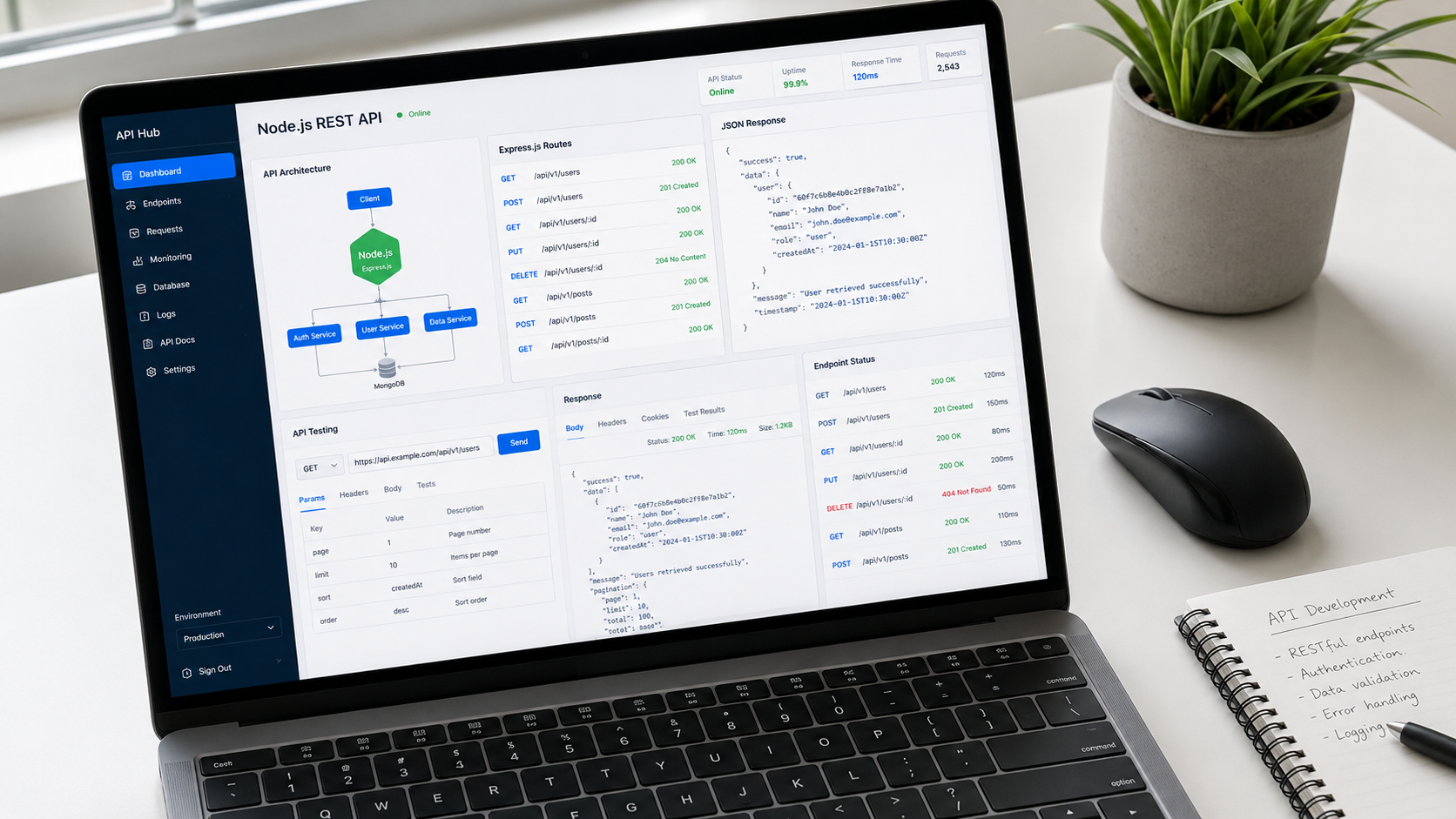
We build versioned, documented REST APIs with consistent response schemas, JWT or OAuth 2.0 authentication, rate limiting, Zod input validation, and OpenAPI documentation. Built for frontend teams and third-party integrations to depend on across years of product evolution.

We build real-time features live chat, collaborative editing, push notifications, and live dashboards using Socket.io or native WebSockets on Node.js. Redis Pub/Sub handles horizontal scalability so the architecture moves from single to multi-instance without a real-time layer rewrite.
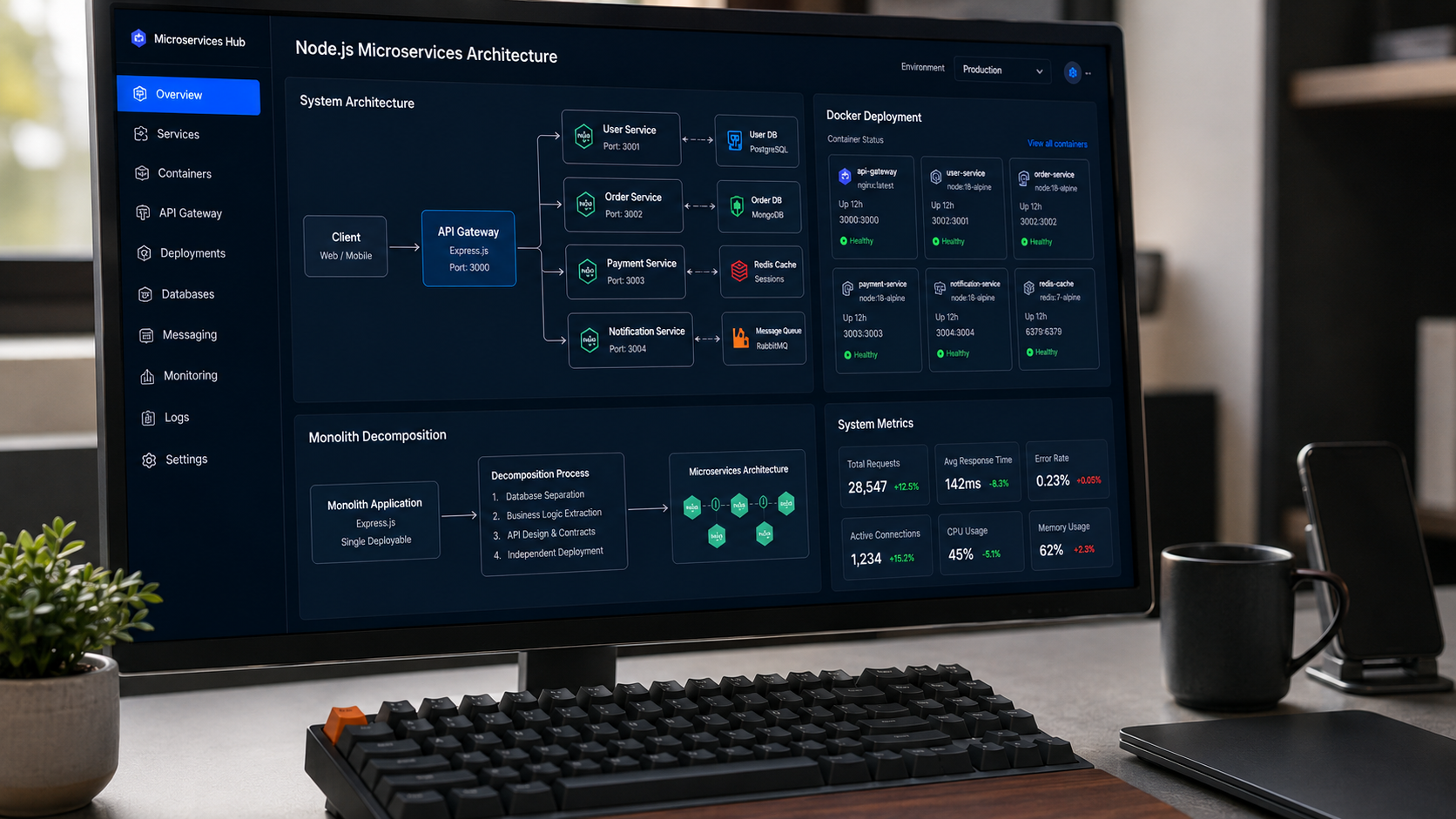
We design Node.js microservice architectures with clear domain boundaries, event-driven inter-service communication, distributed tracing, and API gateway configuration. Our phased monolith decomposition approach extracts services incrementally your team keeps shipping features throughout the transition.

A complete TypeScript application Node.js / Express.js backend, React or Vue.js frontend, shared types across the stack boundary gives your team a unified mental model and eliminates the integration bugs that appear when frontend and backend work in different languages with no shared contract. See our UI/UX design services for full-stack delivery.

We build SaaS backends with multi-tenancy, Stripe subscription billing, usage metering, and tenant-isolated job queues designed from the architecture phase not retrofitted after launch. Subscription edge cases upgrades, failed payments, reactivation handled without manual support intervention.
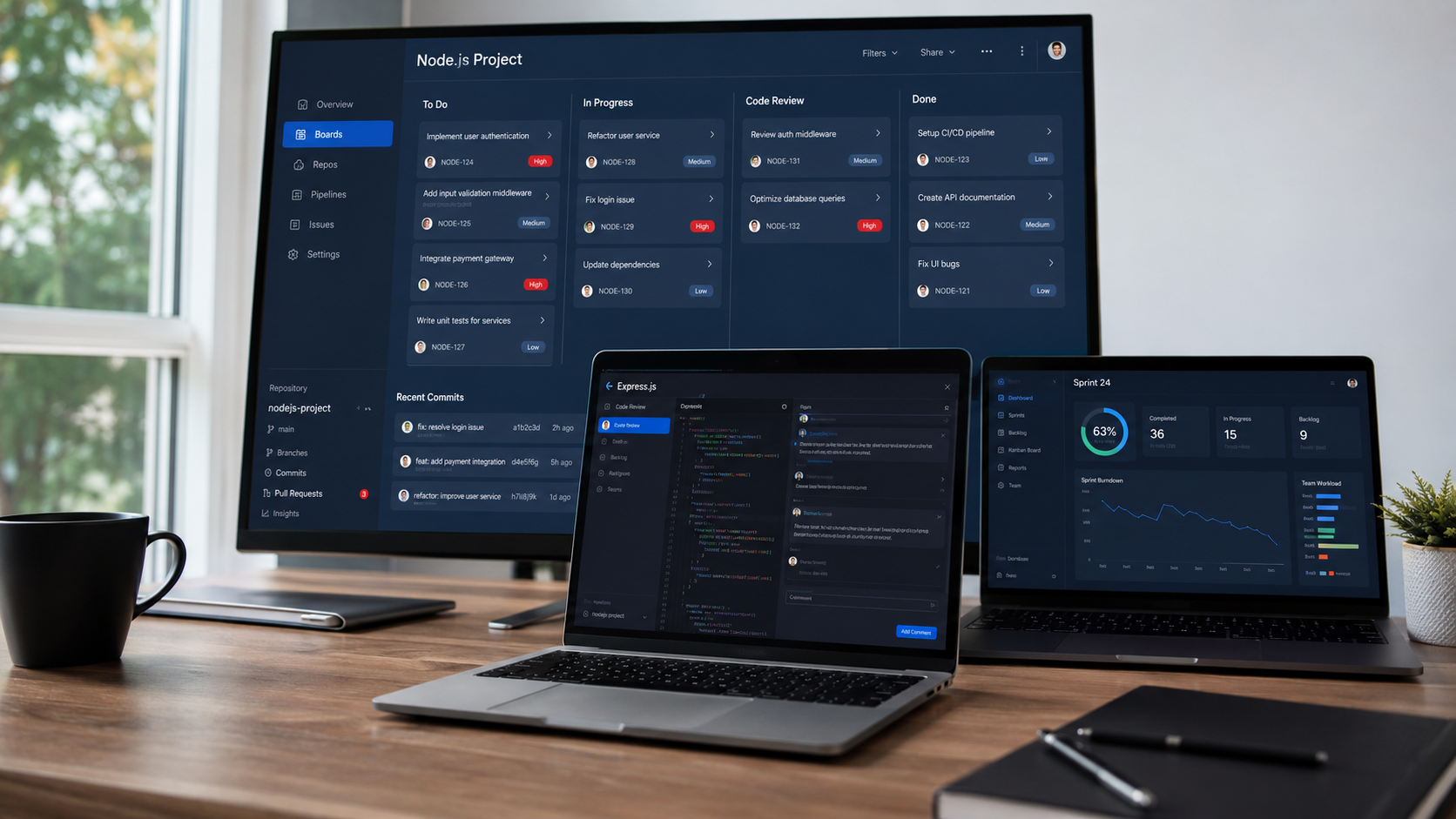
Our dedicated Node.js developers embed directly in your team using your Git workflow, your tooling, and your sprint cadence with direct developer access from day one. Engagements run on monthly retainer terms. Clients across the US, UK, and Australia access senior Node.js expertise within days of a signed agreement.
A structured, milestone-driven process from discovery to post-launch support with no surprises along the way.
Structured discovery covering performance requirements, data model, third-party dependencies, and concurrency expectations. NDA signed before any discussion begins. Deliverable: technical architecture document, API contract outline, and deployment strategy all confirmed before the proposal is issued.
We finalise the OpenAPI contract endpoints, schemas, authentication flows, and versioning strategy so frontend teams have a stable integration target from the start. For full-stack projects, our designers produce Figma wireframes before development begins. See our UI/UX design services for detail.
Two-week sprints on a shared staging environment. Route handlers, middleware, database models, authentication, job queues, real-time event handling, and third-party integrations delivered in deployable increments. TypeScript is standard. Working software at the end of every sprint not status updates.
Unit and integration tests with Jest, load testing with k6 on performance-critical routes, OpenAPI contract validation, and a security review covering OWASP Node.js vulnerabilities. Nothing ships to production without a cleared QA checklist and a documented performance baseline.
Deployed to AWS, GCP, or DigitalOcean with CI/CD via GitHub Actions, APM monitoring, and Sentry error tracking configured before go-live. Full documentation, runbook, and knowledge transfer are standard. Post-launch support retainers available on monthly terms.
Every technology choice is deliberate selected for your project's specific performance, scalability, and maintainability requirements.











































200+ businesses across the US, UK, Germany, Australia, and UAE have trusted Encrypted InfoWeb. Here is what consistently sets us apart.
We understand the event loop, async error handling, memory leak diagnosis, and the operational realities of running Node.js at scale not just framework APIs covered in tutorials.
Most backend agencies stop at the API boundary. We pair Node.js backends with UI/UX design and frontend development for complete product delivery under one contract.
Queue strategy, caching layers, database connection pooling, and service boundary decisions are made at the architecture phase before they become expensive migration projects at growth stage.

Event loop monitoring, distributed tracing with OpenTelemetry, and load testing before production launch are standard deliverables not optional add-ons. Every project ships with a documented performance baseline.
Consistent senior-level Node.js delivery for clients in the US, UK, Germany, Australia, and the UAE. English-first documentation, direct developer communication, and a track record of on-schedule delivery.
Two-week sprints, working software on staging at the end of every cycle, and direct developer access without an account manager in the middle. You always know exactly where your project stands.
Node.js has specific strengths by sector. Here is how we apply them for each type of client we serve.
Unified JavaScript stack, fast API delivery, and a codebase structured for a 10x team. Node.js gives startups the scalability headroom to grow without a backend rewrite at Series A.
Multi-tenant API backends, Stripe subscription integration, and usage metering. Node.js handles SaaS API concurrency natively at lower infrastructure cost than synchronous alternatives.
HIPAA-aware Node.js APIs for patient portals, clinical data pipelines, and medical device integrations with encryption, strict access control, and audit logging in the architecture.
High-concurrency product APIs, real-time inventory updates, and ecommerce backends that handle traffic spikes without performance degradation.
Node.js microservices for enterprises decomposing monoliths, building internal API gateways, or introducing event-driven architectures across the US, UK, and UAE.
Our async-first delivery model provides consistent, senior-level Node.js engineering for clients worldwide.
Serving US startups, SaaS companies, and enterprises across New York, San Francisco, Austin, and Chicago with fast onboarding, direct communication, and deliverables that hit commercial targets.
Full GMT timezone overlap, GDPR-aware API architecture, and the direct communication standard British B2B clients expect. We work with CTOs and technical leads directly across London, Manchester, and Edinburgh.
Technical precision, DSGVO-compliant data handling, and meticulous documentation for Mittelstand businesses and technology firms across Berlin, Munich, and Frankfurt.
Async-first workflows and partial AEST timezone overlap for clients across Sydney, Melbourne, and Brisbane structured, direct, and on schedule.
Node.js platforms with multi-language support, Arabic text handling, regional payment gateway integration, and enterprise security standards for clients across Dubai, Abu Dhabi, and the broader GCC.
Whether you are building a new API, adding real-time features, or decomposing a monolith we are ready to start properly.