Our UX Research & Usability Testing Services
From moderated usability sessions to comprehensive UX research programmes every method calibrated to the specific question your product needs answered.

Encrypted InfoWeb delivers professional UX research and usability testing services for startups, SaaS companies, ecommerce brands, and enterprise product teams that need to understand why users behave the way they do not just what the data shows they do. Serving clients across the United States, United Kingdom, Germany, Australia, and the UAE.
Book Free Consultation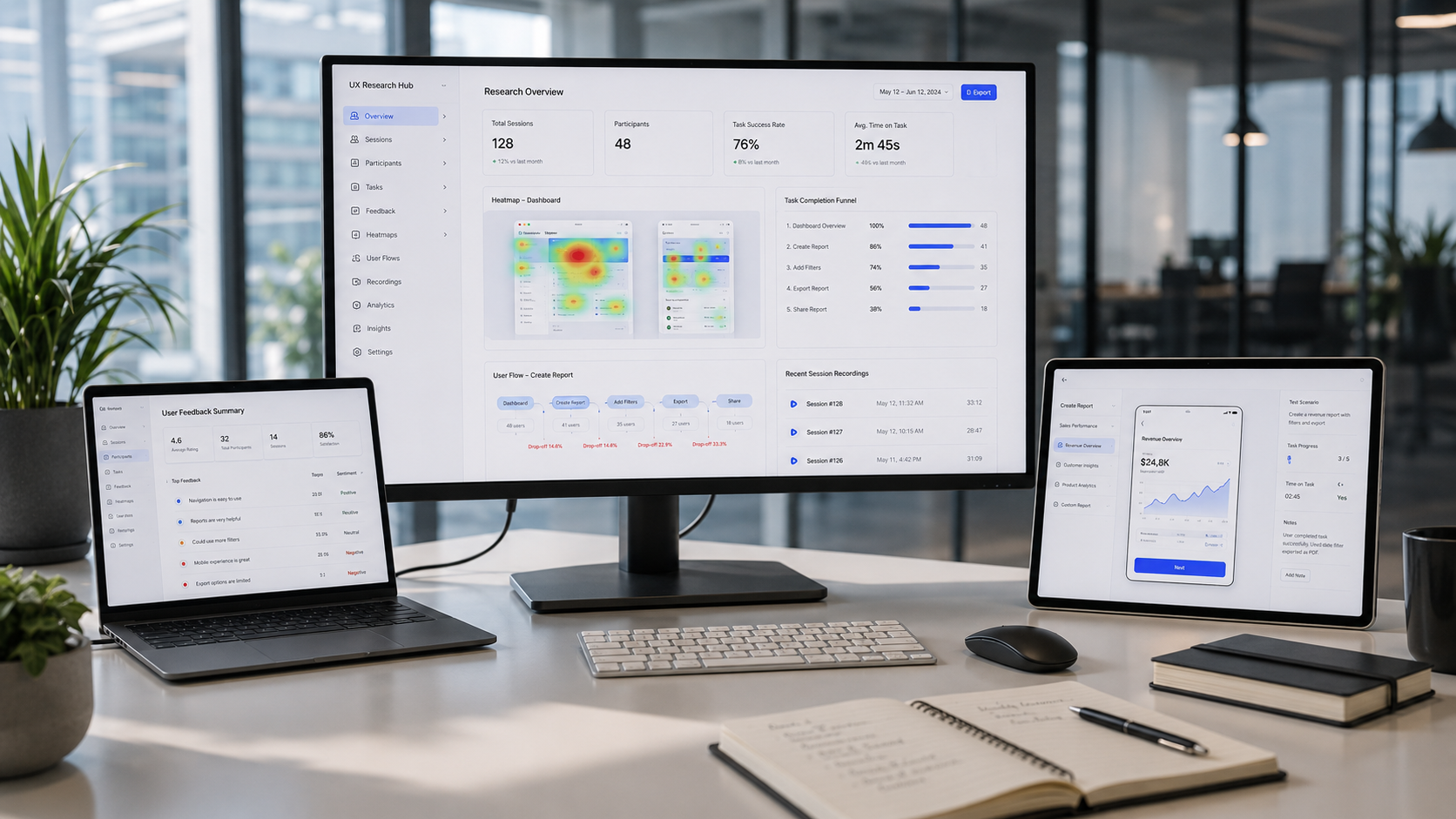

10+ Years
Experience in digital delivery

200+ Projects
Across web, apps & software

Global Client Coverage
Global delivery & collaboration

NDA Ready
Confidential, IP-aware workflows
UX research and usability testing services involve systematically studying how users interact with a digital product to identify friction points, navigation failures, and unmet needs. Methods include moderated and unmoderated usability sessions, user interviews, heuristic evaluation, and analytics-based behavioural analysis producing prioritised, actionable findings that directly inform design and product decisions.
Most clients come to us after internal assumptions about user behaviour have led to the wrong design decisions. Research replaces those assumptions with evidence.
Analytics tell you where users leave. They do not tell you why. Usability testing puts a real user in the flow and reveals the specific moment, element, or confusion that causes the exit giving your team a concrete problem to fix rather than a metric to watch.
A feature that took three sprints to build and has 4% adoption has either a discoverability problem, a value communication problem, or a UX problem. User research identifies which before another sprint is committed to fixing the wrong thing.
When the same navigation question appears in support tickets, user forums, and onboarding calls, it is not a user education problem it is a design problem. UX research identifies the structural cause and provides the evidence needed to prioritise the fix.
Product, engineering, and design all have different opinions about what users need most. User research surfaces what users actually want and provides the prioritised evidence that resolves internal disagreements without a politics-based decision process.
Quantitative testing tells you which variant performs better. It does not tell you why which means the next test is still a guess. Qualitative research provides the behavioural context that makes A/B test results interpretable and directionally predictive.
Consumer product assumptions applied to enterprise tools produce interfaces that look good in demos and fail in daily use. Research with actual enterprise users particularly in Germany and the UK where usage patterns differ from US consumer norms is the only reliable basis for enterprise product design decisions.
Here is who gets the most value from professional UX research and usability testing and what each type of organisation gains.
Validate product-market fit assumptions and identify navigation problems in a prototype before development budget is committed. Research at the prototype stage costs days to act on. The same findings discovered post-launch cost sprints.
Activation rates, feature adoption, and churn are all downstream of UX quality. Research identifies the specific friction points in onboarding and core flows that your analytics confirm exist but cannot explain giving engineering a prioritised, evidence-based queue.
Enterprise user behaviour differs significantly from consumer behaviour and from the assumptions of product teams who primarily use consumer apps. Research with real enterprise users across the US, UK, and Germany produces findings that consumer-centric UX heuristics miss entirely.
Before committing to a full redesign, research on the current product identifies which elements cause the most friction so the redesign addresses structural problems rather than surface-level aesthetic ones that were not causing the commercial outcomes being blamed on design quality.
From moderated usability sessions to comprehensive UX research programmes every method calibrated to the specific question your product needs answered.
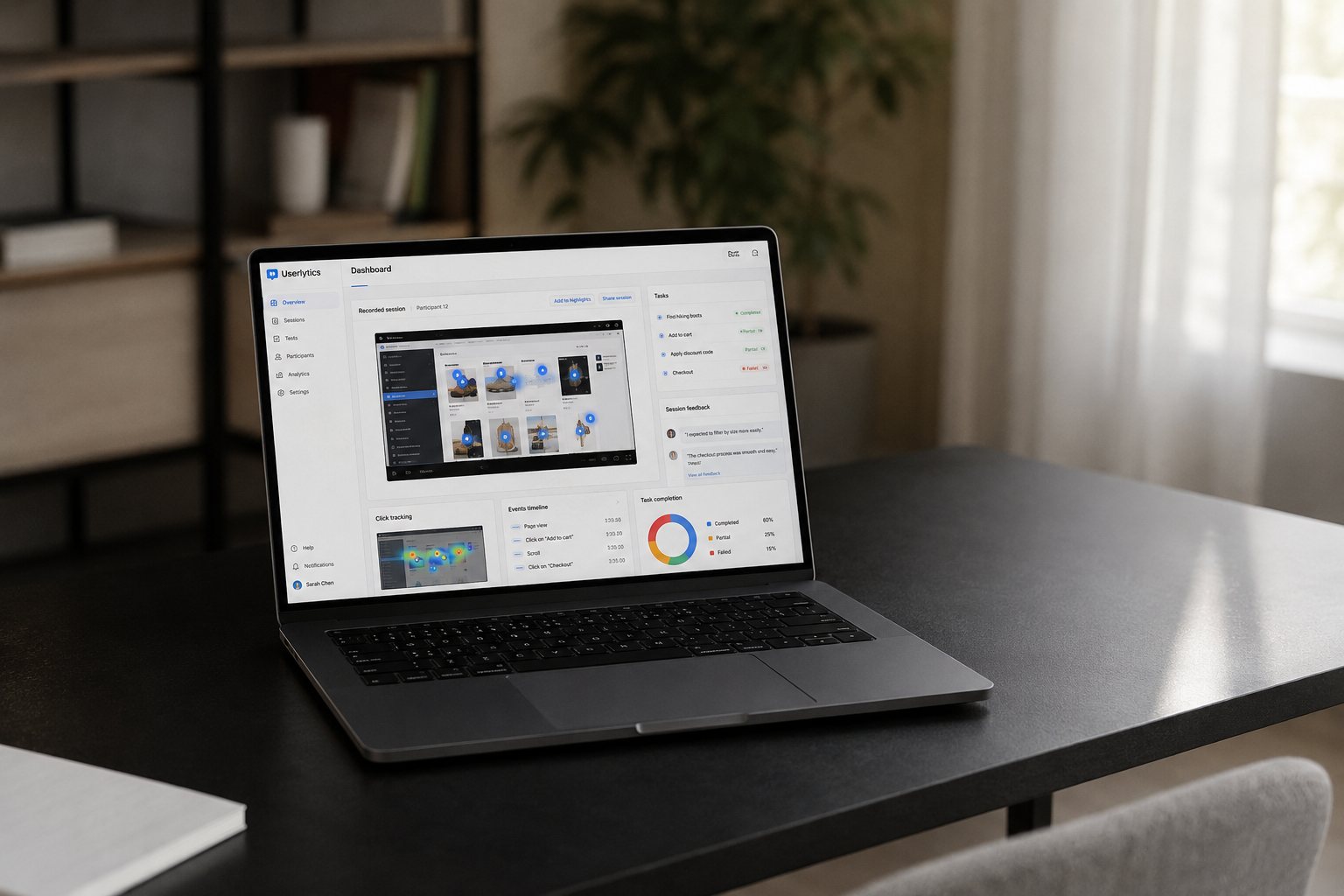
We recruit participants matching your target user profile, design task-based test scripts, and facilitate live usability sessions observing in real time as users attempt to complete key product flows. The facilitated session format lets us probe for the reasoning behind user behaviour, not just observe it. Sessions are recorded and analysed for a prioritised findings report your team can act on directly. See our interactive prototyping services for prototype testing.
For faster turnaround and larger participant samples, we design and deploy unmoderated usability studies via Maze or UserTesting with defined task flows, success metrics, and quantitative completion and error rate tracking. Unmoderated studies are particularly effective for benchmarking existing performance, comparing design variants, and measuring the impact of a design change across a statistically meaningful sample size rather than a moderated session cohort of five to eight.
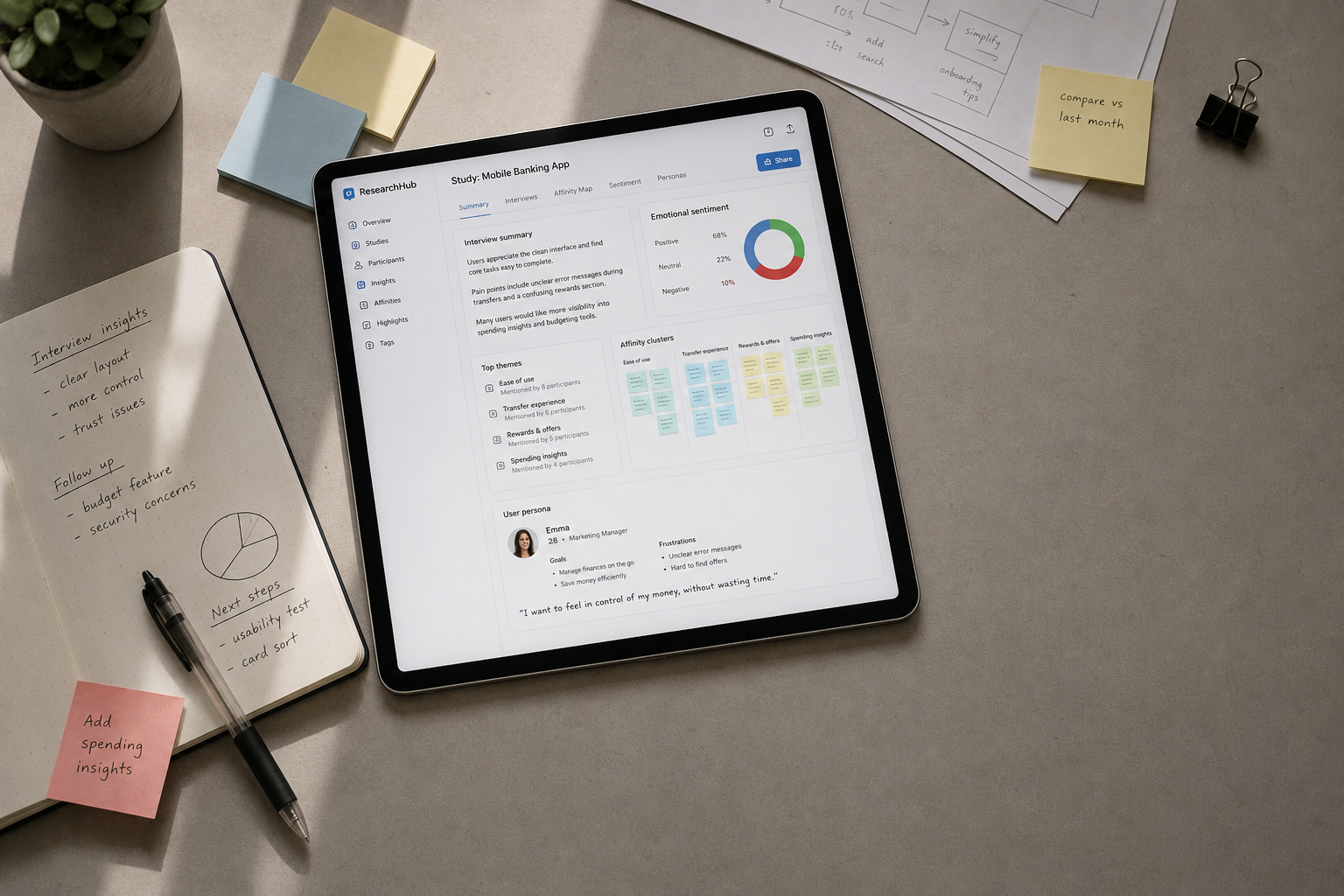
We design and conduct structured user interviews to understand the mental models, motivations, pain points, and decision-making processes behind user behaviour the contextual layer that usability metrics alone cannot provide. Interview research is the foundation for accurate persona development, jobs-to-be-done mapping, and the product strategy decisions that flow from understanding what users are actually trying to accomplish rather than what the feature spec assumes they are. See our full UI/UX design services.

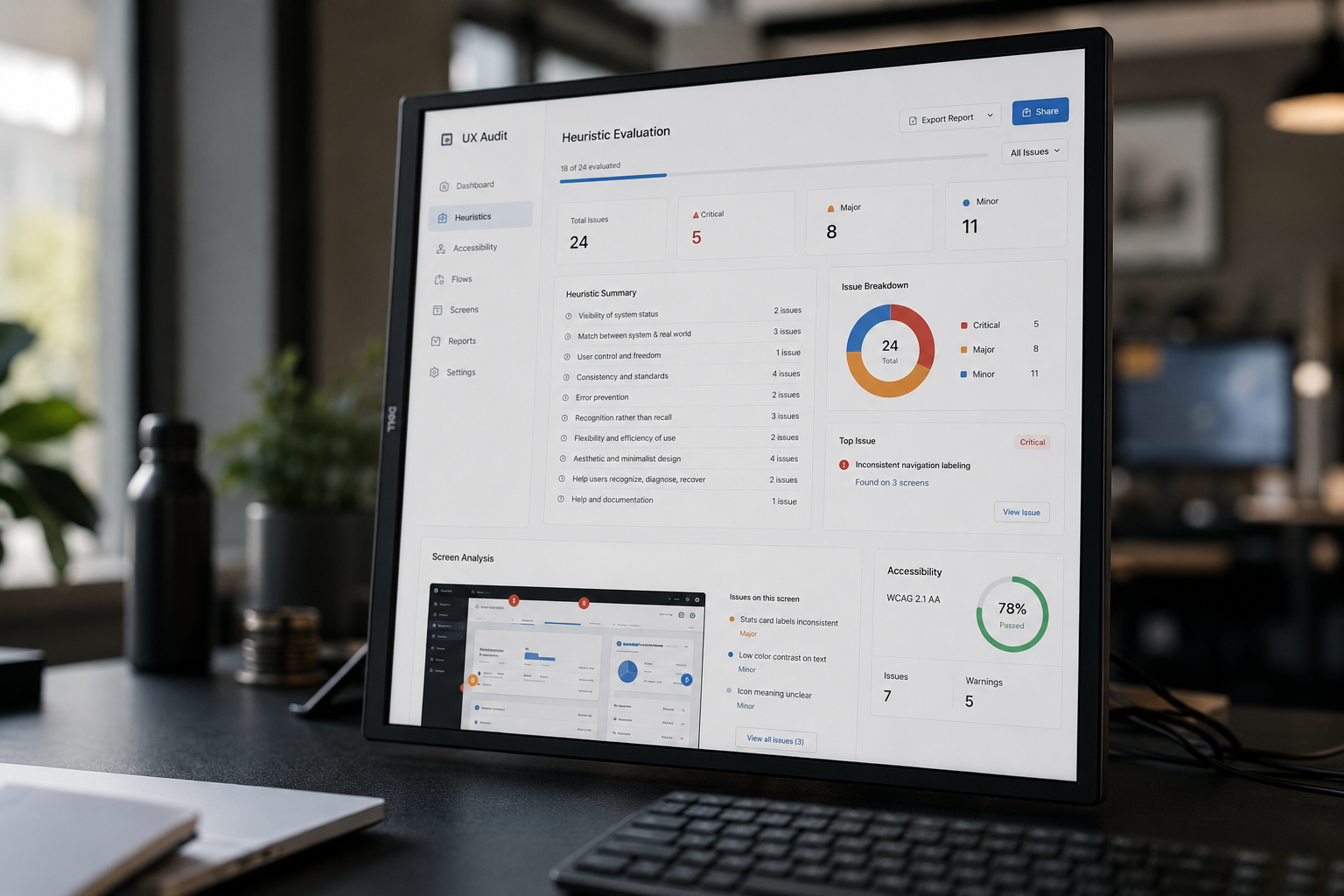
When full user research is not yet feasible because the product is in early design stage or budget does not allow a full participant study an expert heuristic evaluation applies Nielsen's 10 usability principles and domain-specific UX heuristics to identify structural problems in the current design. We deliver a severity-rated audit report with specific findings, screenshots, and recommended corrections, structured so your design and product teams can prioritise and act without ambiguity. Complements our wireframing services.
Hotjar heatmaps, session recordings, funnel analysis, and product analytics from Mixpanel or Amplitude tell a quantitative story about user behaviour that session-based research can contextualise. We combine analytics data with qualitative findings to produce a complete picture of where users struggle, why they struggle there, and which changes are most likely to produce measurable improvement in the metrics your business tracks. See our web development services for analytics implementation.
A structured, milestone-based research process from brief to actionable findings no ambiguity at any stage.
We establish the research question, identify the decisions the research needs to inform, agree on methodology, and define the participant profile. NDA signed before any discussions begin. Deliverable: research brief and study design document before recruitment begins.
We design task scripts or interview guides, configure the testing platform, and recruit participants matching your target user profile. For prototype testing, we work with your interactive prototype. For live product testing, we configure the relevant analytics or recording tools.
We conduct moderated sessions, deploy unmoderated studies, run interview series, or perform heuristic evaluations depending on the agreed methodology. Sessions are recorded with participant consent and catalogued for systematic analysis.
We analyse all session data, identify patterns across participants, and categorise findings by severity and frequency. Affinity mapping, thematic analysis, and quantitative metric review are all applied before the findings report is structured.
We deliver a severity-prioritised findings report with specific recommendations ready for your product backlog. Integration with UI/UX visual design and development available for end-to-end delivery from research to redesign.
Research methodology and tooling selected for the specific study type not a default stack applied to every engagement.













































200+ businesses across the US, UK, Germany, Australia, and UAE have chosen Encrypted InfoWeb. Here is what distinguishes how we conduct and deliver UX research.
We understand how research findings translate into design decisions. Our researchers have designed products as well as studied them which means findings are framed in terms your design and engineering teams can act on, not academic UX language that needs translation.
We design every study around the specific decision you are trying to make not a generic research protocol. The research question drives the methodology, the participant profile, the task design, and the analysis framework.
Findings feed directly into UI/UX visual design and development within the same team no research-to-design handoff gap where findings get diluted or misinterpreted in translation.

Research reports that present every finding without prioritisation are not useful. We deliver severity-rated findings with specific, actionable recommendations structured for the product backlog so your team knows what to fix first and why.
We run research studies with participants in the US, UK, Germany, and Australia understanding the cultural and professional behavioural differences that affect product usability across different markets and user populations.
All research is conducted with participant consent, GDPR-compliant data handling, and under NDA. Your product concept, user data, and research findings are protected throughout. See our full UI/UX design services.
The research questions that matter differ significantly by sector and we bring industry-specific methodology and participant understanding to every study.
Prototype and early-product usability testing before development budget is committed validating key flows with real users rather than internal team assumptions.
Activation flow testing, feature adoption research, and onboarding usability studies that identify the specific friction causing trial churn before it becomes a cohort pattern.
Task-critical usability testing for patient portals and clinical tools with GDPR/HIPAA-compliant participant handling and the accessibility audit standard healthcare products require.
Purchase funnel usability studies identifying where and why users abandon with specific checkout, navigation, and product discovery findings that feed directly into conversion rate optimisation.
Enterprise user research across US, UK, and German markets multi-role usability testing, complex workflow analysis, and enterprise-context interviews that consumer UX heuristics miss entirely.
Our remote-first research model enables participant recruitment and study execution across multiple markets with the compliance and documentation standards each region requires.
UX research and usability testing for US product teams across New York, San Francisco, and Austin consumer and enterprise participant recruitment, fast study turnaround, and findings structured for agile sprint cycles.
GDPR-compliant UX research for UK clients in London, Manchester, and Edinburgh professional participant screening for B2B studies, full GMT timezone overlap, and findings documentation to enterprise governance standards.
DSGVO-compliant usability studies for German businesses in Berlin, Munich, and Frankfurt with German-speaking participant options, formal research documentation, and cultural context that differs meaningfully from US-centric UX assumptions.
UX research and usability testing for Australian product teams in Sydney, Melbourne, and Brisbane async-first delivery, direct communication, and participant recruitment across Australian B2B and consumer user populations.
UX research for enterprise and SaaS products across Dubai, Abu Dhabi, and the GCC Arabic-language user research capability, cross-cultural usability testing, and findings structured for the enterprise governance processes that UAE clients typically require.
Let's find out what your users actually struggle with and give your team the evidence to fix the right things first.