
What Is Hospital AI Implementation?
Hospital AI implementation is the process of embedding an AI capability into a hospital's existing systems, workflows, data, governance and ownership structures — not just running it as a pilot or demo. A hospital can have an impressive AI demonstration without having an effective AI implementation, and clients evaluating vendors should treat that distinction as the first filter, not an afterthought.
For example, an AI system might successfully summarise clinical notes during a demonstration. But if clinicians have to export information manually, upload it into another application, wait for the result, copy the output back into the EHR and then verify everything independently, the technology has created another task instead of removing one. A comprehensive hospital AI implementation plan connects the technology to the work that already happens, using interoperability (the ability of an EHR, a lab system and an AI tool to exchange data without manual re-typing) and standards such as FHIR (Fast Healthcare Interoperability Resources) to make that connection secure and repeatable.
A modern implementation combines AI integration consulting, a defined data and interoperability layer, and intelligent automation tools such as AI business automation built directly into clinical and administrative workflows.

- ✓Patient, clinical, operational and administrative data available in usable formats
- ✓Secure integration connecting the AI to the EHR, clinical applications and other systems
- ✓AI appearing at the right point in the clinician's or administrator's existing workflow
- ✓Clinicians, administrators and IT teams who understand how and why the system is used
- ✓Appropriate privacy, security, monitoring and accountability controls
- ✓A clear definition of what success means before the organisation scales
Why Hospital AI Pilots Die After 6 Months
Understanding why pilots stall is the foundation of any effective hospital AI implementation plan. A successful pilot only proves the model works in a controlled setting; production demands reliable data, workflow integration, governance and user adoption that the pilot never had to prove. Here is how that pilot-to-production gap typically opens up.

Promising Demo & Successful Pilot
The model performs well with a small, motivated group of users and clean, hand-picked data.
Integration & Workflow Friction
The AI has to work with legacy systems, real patient data and full workloads — and starts creating extra steps instead of removing them.
Declining Usage & Unclear ROI
As friction builds, clinicians quietly stop using the tool and leadership struggles to point to a measurable outcome.
Ownership Uncertainty & Stall
Without clear post-pilot ownership and funding, the project loses momentum — not because the model failed, but because the implementation did.
Key insight: “Six months” is a practical warning point, not a universal statistic. AI projects run on different timelines depending on clinical use case, regulatory requirements, integration complexity and organisational readiness.
Six Foundations of Successful Hospital AI Projects
Every scalable healthcare AI programme rests on the same six pillars, regardless of the clinical department or use case. Scalable healthcare AI is fundamentally a software engineering and workflow problem as much as an AI problem — the layers around the model decide whether it survives contact with production.
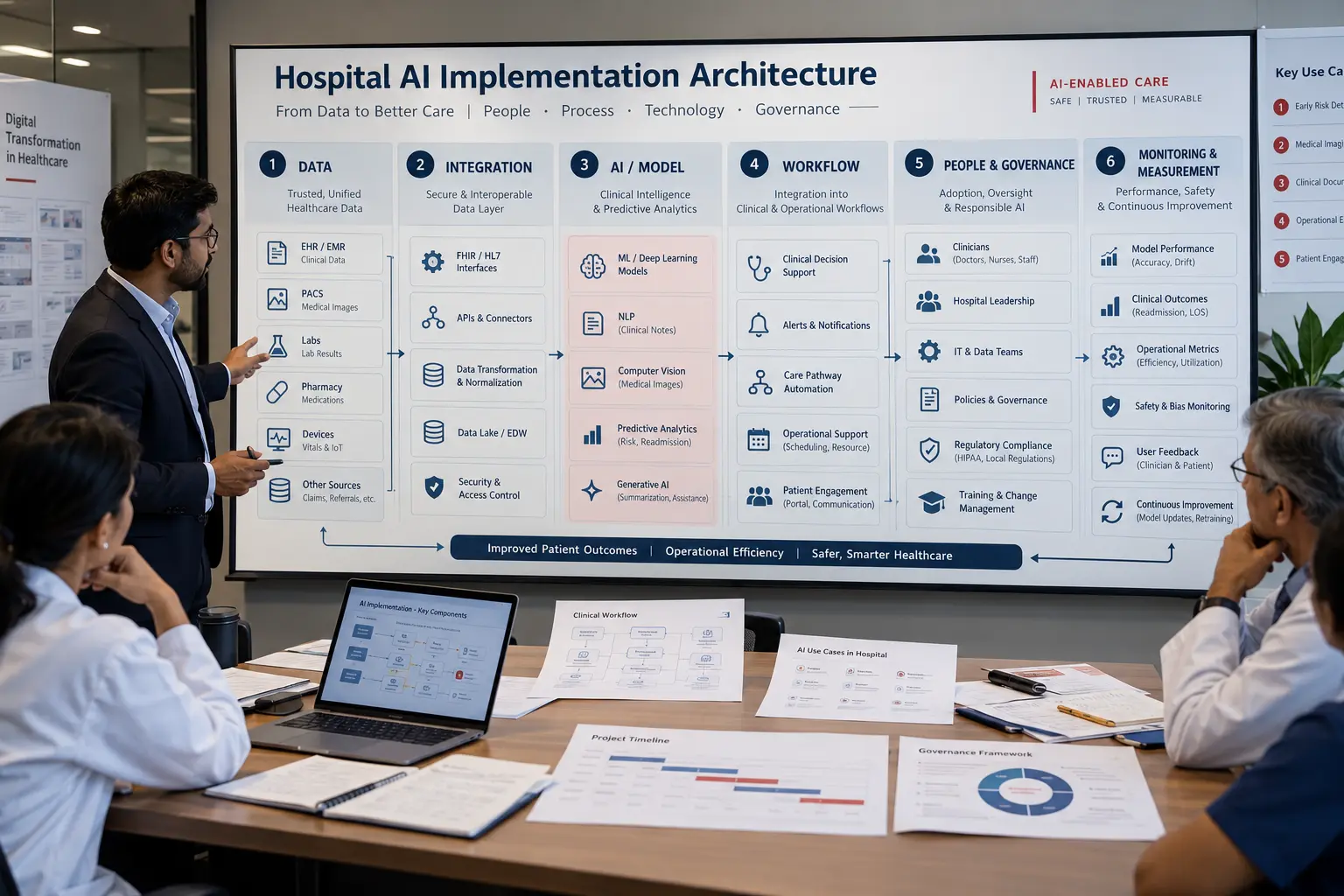
Reliable Data
AI quality is constrained by the quality and accessibility of its inputs across EHR, lab, imaging and billing systems.
Integration
A production system needs to communicate with the rest of the technology environment, not sit apart from it.
Human Oversight
AI supports a clinician's judgment — summarising, flagging, recommending — it does not replace clinical decision-making.
Governance & Monitoring
Ongoing visibility into what the system does, who can access it, and how errors are reported.
The Five Layers of the Technology Stack
What Hospital Leaders Should Ask Before Scaling an AI Pilot
Before approving a larger deployment, leadership should be able to answer six questions with evidence, not intuition — this is one of the fastest ways to separate a pilot that is ready to scale from one that only looks ready.

- ✓Does the AI solve a real operational problem?
- ✓Does it fit into the existing clinical or administrative workflow?
- ✓Is the underlying data reliable enough to scale on?
- ✓Can the system integrate with existing EHR and clinical technology?
- ✓Can users report problems and influence improvements?
- ✓Can we measure the value it has created so far?
Reality check: according to the American Medical Association's 2024 physician sentiment survey, physicians ranked a designated feedback channel (88%), data privacy assurances (87%) and EHR integration (84%) among the attributes most important for advancing AI adoption — workflow fit and trust, not raw model accuracy, are what determine whether a tool keeps getting used.
How Hospital AI Implementation Actually Works
Hospital AI implementation runs as a seven-step path from an operational problem to a monitored, owned production system — not as a single software install. It starts with identifying the workflow problem and mapping how work actually happens today, before any AI is chosen. From there, the path runs through four further stages.

Assess the Data
Determine where the required data lives, whether it is complete and consistent, and which system owns the source data. Weak data here undermines everything built on top of it later.
Design the Integration Architecture
The AI should not become another disconnected application. A well-designed path runs EHR → integration layer → data processing → AI service → validation → workflow application → audit/monitoring, with FHIR or an equivalent standard doing the connecting.
Validate With Real Users, Then Measure Production Performance
Clinicians and operational staff test the system before deployment and confirm it doesn't interrupt their workflow. Once live, it needs predefined success metrics — time saved, adoption, exception rate, error rate and cost per transaction — not just model accuracy.
Scale Deliberately
Only after the workflow is stable, and long-term ownership is assigned, should the hospital expand to additional departments, locations or use cases — as an engineering decision, not just more users. Encrypted Infoweb builds this operationalisation path through AI integration consulting and enterprise CRM and data platforms, so a pilot doesn't stall for lack of a plan to grow it.
Why Healthcare AI Adoption Depends on Workflow
Healthcare AI adoption depends on whether the technology fits a clinician's existing workflow — not on how accurate the model is or how much training staff receive. Treating adoption as a training problem is one of the biggest and most common mistakes in AI projects.
The Cost of a Separate Application
A clinician already works across an EHR, a messaging system, scheduling software and several specialist applications. Adding another AI application that must be opened separately, fed information manually, and copied back into the EHR creates friction. The AI might be accurate. The workflow is still broken.
Human Oversight as a Design Requirement
Wherever AI touches clinical decision-making, oversight is not optional. AI can support a clinician's judgment — summarising, flagging or recommending — but it does not independently replace clinical decision-making. Human review, validation before deployment and clear escalation paths keep AI-supported decisions safe rather than autonomous.
The lesson: AI adoption happens when the technology fits the workflow — not when the workflow is forced to fit the technology. Fit and trust, not raw accuracy, are what physicians say determine whether they keep using a tool.
Common Mistakes That Kill AI Pilot Projects
Most AI pilots die from the same short list of preventable mistakes — almost none of them about the model itself.
- ✓Starting with the model instead of the operational problem
- ✓Ignoring data quality, since inconsistent or inaccessible data undermines the whole project
- ✓Building a standalone tool that adds friction to established systems
- ✓Leaving clinicians out of the design, since technology teams cannot define clinical workflows alone
- ✓Measuring model accuracy only, when an accurate model can still fail if nobody uses it
- ✓Treating security as a final step instead of part of the architecture from day one
- ✓Scaling before stabilising, so a flawed workflow simply gets multiplied
- ✓No ownership after the pilot, so nobody owns monitoring, feedback or evaluation after launch
Avoiding this list is rarely about writing better AI — it's about treating implementation as its own project, with its own owner and its own budget, alongside the model work.
How Encrypted Infoweb Helps Hospitals Move From Pilot to Production
Encrypted Infoweb treats healthcare AI as a technology integration and business workflow challenge, not simply an opportunity to add a model. Our capabilities connect AI functionality to existing software, design custom workflows, implement intelligent automation and support AI adoption.
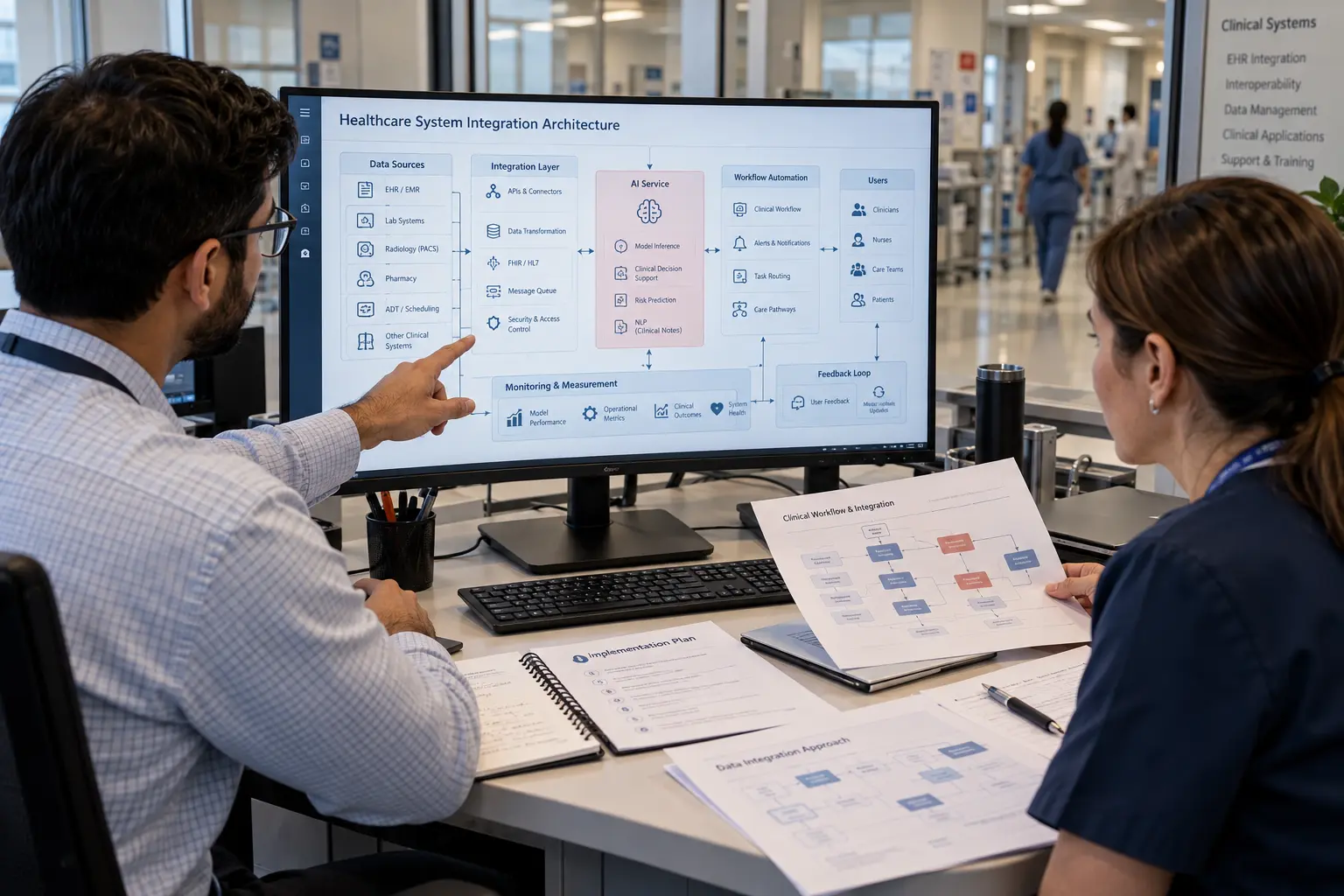
AI Integration & Consulting
AI readiness assessment, technology-stack analysis, integration architecture and use-case prioritisation.
Healthcare Workflow Automation
Document processing, patient intake, referral routing and administrative automation embedded into existing workflows.
Healthcare Data Integration
Reliable data flows across fragmented systems, with appropriate access controls and governance.
AI Adoption & Change Management
User workflows, training requirements, feedback mechanisms and operational ownership built into implementation.

From AI Demo to Hospital Workflow: A Regional Hospital Example
The lesson is not that the hospital needed a better AI model — it needed a better implementation around the AI, with the metrics above defined and tracked from day one.
Ready to Turn a Hospital AI Pilot Into a Scalable System?
Encrypted Infoweb helps hospitals connect AI to existing software, data and clinical workflows — and builds toward measurable operational goals, not just a working demo.
Book a Consultation →Conclusion: Hospital AI Implementation Is Bigger Than the AI Model
Hospital AI pilots rarely fail because artificial intelligence suddenly stops working. They fail because the surrounding system isn't ready to support it — data fragmented, integrations incomplete, workflows poorly designed, clinicians without visibility, governance unclear, and success never defined.
The strongest approach to hospital AI implementation starts with the operational problem and works backwards: identify the workflow, understand the data, design the integration, involve users, build governance into the architecture, measure operational outcomes, then scale.
The competitive advantage won't go to the hospital with the most AI pilots — it will go to the one that turns useful AI capabilities into reliable, integrated and adopted workflows. Contact us today for a free consultation.
This guide was produced by the technology specialists at Encrypted Infoweb — a global technology partner helping organisations use software, AI and automation to improve operations, customer experience and sustainable growth. For healthcare organisations, our focus is simple: build technology that works within the operational environment, not technology that only looks impressive in a demonstration. Trust signals: verified industry research · illustrative implementation example · actionable step-by-step guidance.