
What Does It Mean for an AI-Built App to Be Production-Ready?
Production readiness is the process of proving an AI-generated application continues to work safely and reliably under real conditions — not just that it worked once in a demo. A founder evaluating their own vibe coded app should treat that distinction as the first filter, not an afterthought.
During a demo, you typically have one user, a small amount of test data, a stable connection and a limited number of actions. In production, the application has to deal with different devices, unexpected inputs, concurrent users, network failures, security threats and ongoing data changes. Generating an application and preparing it for real-world use are two different engineering tasks.
A production-ready application needs appropriate security controls, reliable data handling, error recovery, testing, monitoring and a maintainable deployment process on top of its working features. Encrypted Infoweb builds this layer through AI integration consulting and cloud infrastructure hardening.

- ✓Authentication and authorization enforced on the server, not just hidden in the interface
- ✓Database access rules that stop one user from reading another user's records
- ✓No private API keys or credentials exposed in frontend code
- ✓Error handling that survives failed APIs, timeouts and interrupted operations
- ✓Automated tests covering critical user journeys, not just manual click-throughs
- ✓Production deployment configuration, monitoring and a documented backup plan
Your App Works in the Demo. Why Does It Break With Real Users?
An AI-generated application can look complete without being prepared for the conditions of a live business environment. Consider a simple appointment-booking app built with an AI coding tool — here is how the gap between demo and production typically opens up.

The Demo Looks Complete
One user, a small amount of clean test data, a stable connection — the account creation, booking form and dashboard all behave exactly as expected.
Real Users Create Edge Cases
Two users book the same slot, someone edits a URL to view another customer's booking, and an email service fails while the booking still gets marked confirmed.
Hidden Issues Surface
A refreshed checkout page submits the same payment twice, and a query that was instant with 20 records takes seconds once history grows into the thousands.
Trust and Reliability Erode
Support requests pile up and customers lose confidence — not because the AI tool failed, but because production conditions were never tested.
Key insight: a demo proves a feature can work, while production readiness requires proving it continues to work safely and reliably under expected and unexpected conditions.
Why AI App Builders Often Stop at the Demo Stage
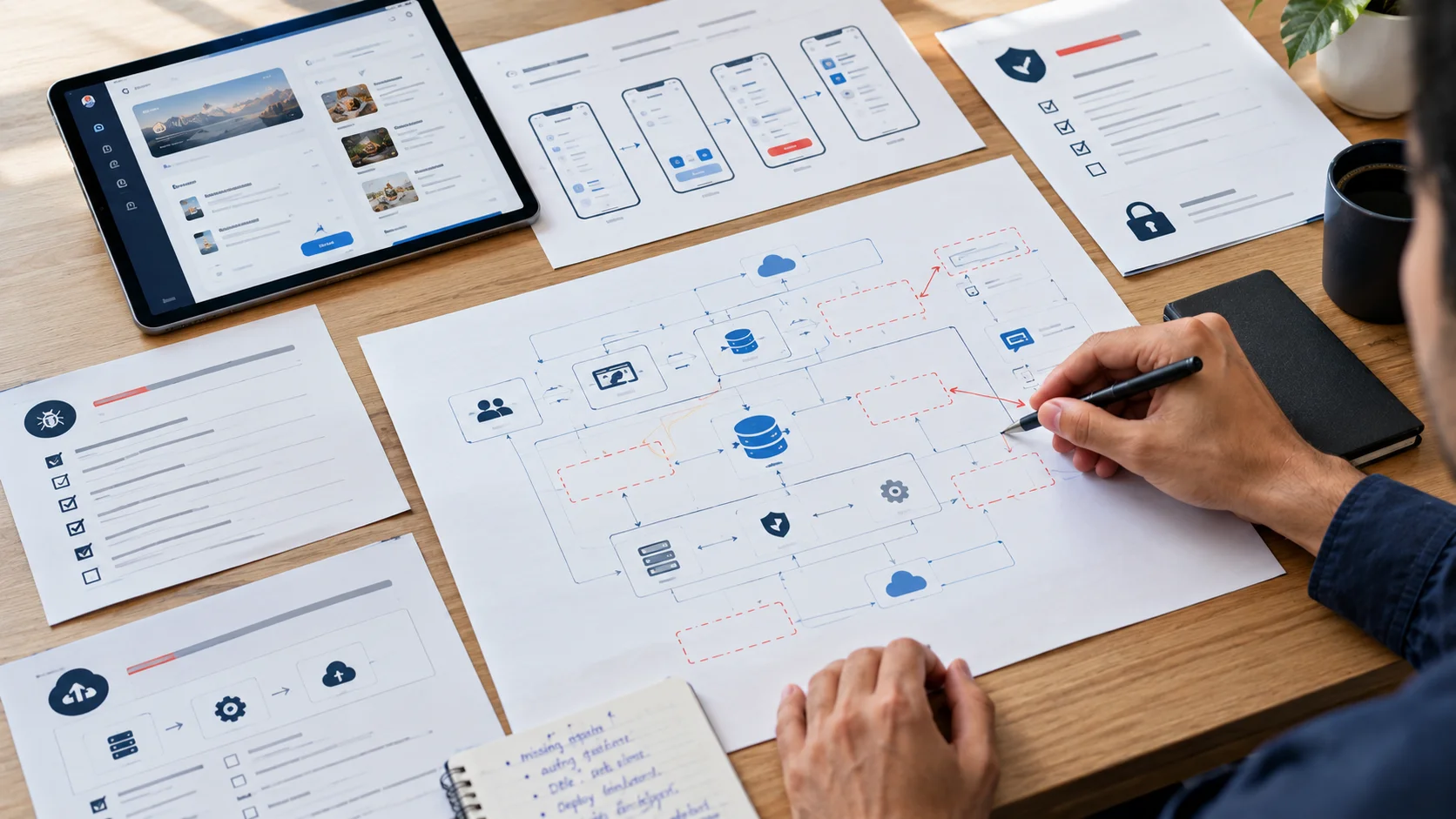
Tools such as Lovable, Bolt and Cursor can accelerate software development by generating code, building interfaces and connecting application components. They don't automatically guarantee that the final result meets your business, security or operational requirements.
Builds What You Ask For
If your prompt doesn't describe the necessary security requirements, the resulting login screen may lack secure session handling, role-based access or account verification.
Doesn't See the Full System
A change in one component can affect several others. Generated code may solve the immediate task without accounting for every dependency or business rule.
Doesn't Validate Production Conditions
An app that works with five test records may behave differently with 50,000, and a form that works with valid input may fail on an empty field or an oversized file.
Human Review Is Still Essential
84% of developers now use AI coding tools, yet only 29% trust the output to be accurate — a gap that engineering judgement and review still have to close.
The Six Areas That Usually Need Hardening
The 10-Point “Is My App Ready?” Checklist
Before making your AI-built application available to real customers, review the following ten areas. A checked item means the control has been verified, not simply that the feature exists.

- ✓Authentication — registration, login, logout, password recovery and session handling have been tested
- ✓Authorization — backend permissions are enforced for every protected action, and users cannot access another user's data
- ✓Secrets — private API keys, credentials and tokens are securely stored and not exposed in frontend code or public repositories
- ✓Data validation — inputs are validated and sanitised on the server, and database operations enforce relevant constraints
- ✓Error handling — API failures, database errors, timeouts and interrupted operations are handled without exposing sensitive information
- ✓Testing — critical user journeys have automated or documented tests, including integration, security and regression checks
- ✓Performance — database queries, API response times and application behaviour have been evaluated using realistic data and traffic
- ✓Deployment — production configuration, HTTPS, environment variables, dependencies and deployment procedures have been verified
- ✓Monitoring & recovery — application logs, error monitoring, alerts, backups and recovery procedures are in place
- ✓Maintenance — the codebase is understandable, dependencies are maintained, and there is a process for reviewing future changes
Reality check: a checklist is a starting point, not a security certification. The depth of testing should match the application's risks, data sensitivity and business requirements — if several of these areas are unverified, the app may still be fine for internal testing but needs further assessment before handling sensitive customer data.
How We Take AI-Built Apps to Production
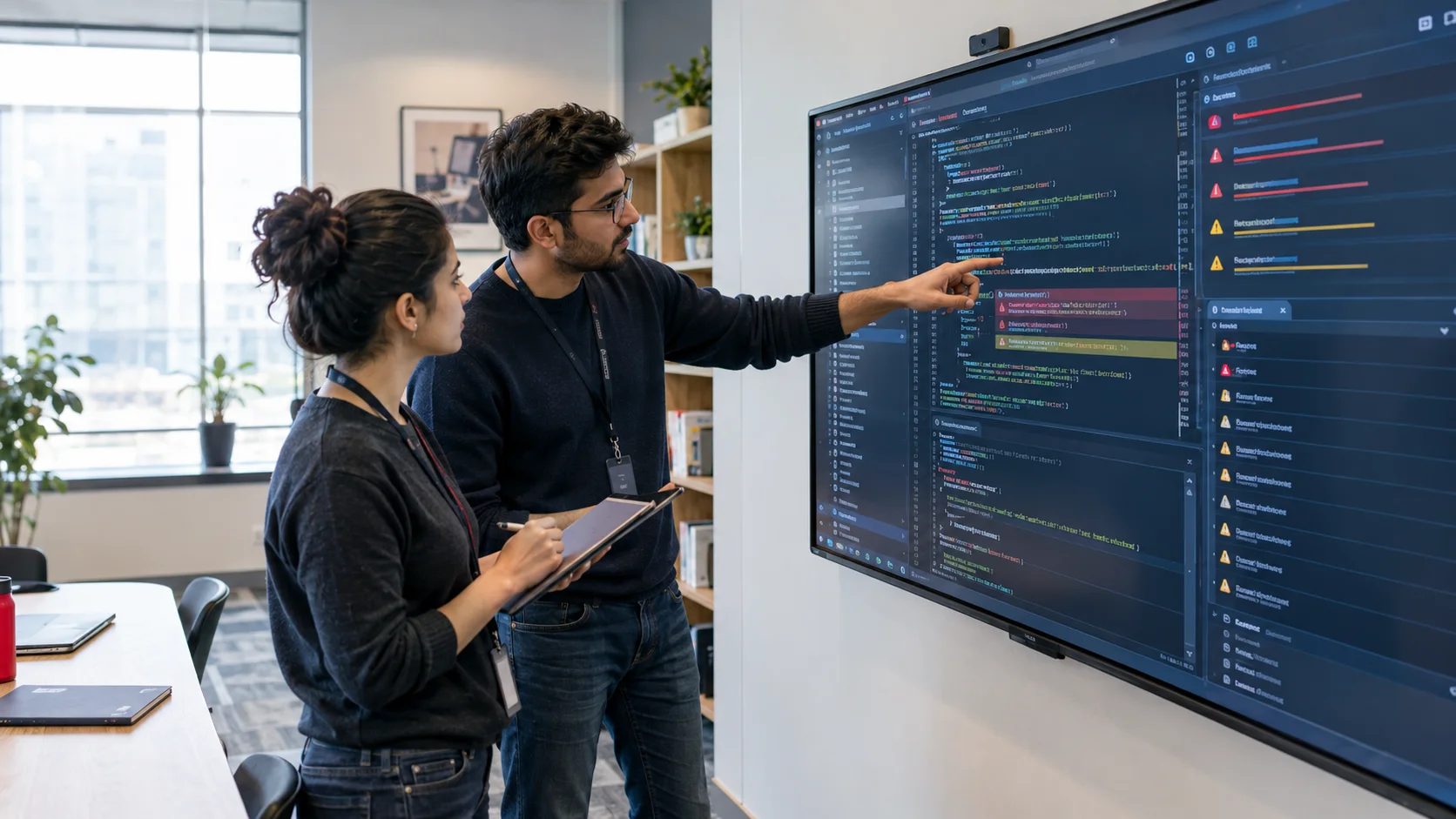
Turning a vibe coded app into a dependable business product runs as a structured path from audit to ongoing maintenance — not a single pass of bug fixes.
Audit and Prioritise the Risks
We review the application's architecture, source code, authentication, database structure, integrations and hosting configuration, then categorise findings by severity, likelihood, business impact and remediation effort. Exposed credentials and payment errors get a different level of urgency than a minor interface inconsistency.
Secure and Improve Performance
We review authentication, authorization, database access rules, API security, input validation and secret management, then assess slow database queries, inefficient API calls and third-party integrations so important business operations behave predictably.
Test Before Deployment
We validate critical workflows — registration, authentication, data access, core transactions, error scenarios and relevant security checks — through appropriate automated and manual testing, and confirm the fixes don't introduce regressions in existing features.
Prepare Production and Establish Maintenance
We review deployment settings, environment separation, HTTPS, database connectivity, monitoring, backups and rollback procedures, then put a defined maintenance process in place — dependency updates, security reviews and bug fixes — so the application stays dependable after launch. Encrypted Infoweb builds this path through AI integration consulting and cloud deployment support.
Fix It or Rebuild It? How to Decide
Discovering problems in an AI-built application doesn't automatically mean you need to start again. The right approach depends on the quality of the existing code, the complexity of the application, the severity of the issues and the effort needed to correct them.
When Fixing the Existing Application Makes Sense
An existing app is usually a good candidate for hardening when its core functionality works as intended, the codebase is reasonably organised, the database structure supports the required business processes, and most issues are isolated to security, configuration, performance or testing rather than the architecture itself.
When Rebuilding May Be Necessary
Rebuilding becomes a consideration when the codebase is heavily duplicated, business logic is inconsistent across components, security problems are deeply embedded in the architecture, or fixing one area repeatedly breaks several others. A rebuild should still begin with a clear understanding of the existing application's requirements, data and user workflows — starting over without addressing the original architectural problems can simply reproduce them.
The lesson: the decision should be based on a technical audit, not assumptions about which tool generated the code. A practical assessment identifies the critical defects, estimates the effort to address them, assesses migration risks, and compares the expected maintenance cost of both approaches.
The 7 Things That Break First in AI-Built Apps
When an AI-generated application starts experiencing problems after launch, the cause is usually found in one of seven areas — almost never the interface itself.
- ✓Login and authentication security — checks performed only in the frontend let users reach protected pages or actions directly
- ✓Database access rules and permissions — missing row-level security can let one customer read another customer's records
- ✓Secret keys exposed in application code — API keys and credentials left in browser-accessible JavaScript can be used by anyone who finds them
- ✓Missing error handling and recovery — a network timeout during payment can lead to a duplicate transaction without proper safeguards
- ✓Insufficient testing — a feature working once doesn't establish that it works reliably across roles, edge cases and future changes
- ✓Slow database queries and poor performance — missing indexes and pagination turn a fast dashboard into a slow one as real data accumulates
- ✓Incorrect hosting and deployment configuration — a build that works locally can fail in production due to different dependencies, permissions or environment variables
None of these are problems with the visual design or the AI tool itself — they are problems with how the application handles real-world conditions that a demo never had to face.
How Encrypted Infoweb Hardens AI-Built Applications
Encrypted Infoweb treats a vibe coded app as a software engineering and security challenge, not simply a prototype to patch. Our capabilities connect security review, performance work, testing and deployment into one practical plan.

Technical Audit & Risk Assessment
A full review of architecture, code, authentication, database structure and hosting, prioritised by business impact.
Security Hardening
Authentication, authorization, database access rules, secret management and input validation brought up to production standard.
Performance & Reliability
Slow queries, error handling and third-party integrations reviewed so core operations behave predictably under load.
Testing & Deployment
Critical workflows validated end to end, with a production environment, monitoring and rollback plan in place before launch.

From Impressive Demo to Secure Launch: A Booking App Example
The lesson is not that the app needed a new AI model or a full rewrite — it needed the engineering layer around it that a prompt alone doesn't generate.
Built Your App With AI and Unsure If It's Ready?
Encrypted Infoweb can assess your application's current state, identify the highest-risk issues, and build a plan to fix or harden it — without assuming you need to start over.
Book a Consultation →Conclusion: A Vibe Coded App Is Bigger Than the Demo That Sold It
AI-built apps rarely fail in production because the AI tool suddenly stops working. They fail because the surrounding engineering isn't ready to support them — authentication incomplete, database permissions missing, secrets exposed, errors unhandled, and testing never done.
The strongest approach to making a vibe coded app production ready starts with an honest audit and works backwards: secure the application, fix performance and reliability, test the critical journeys, prepare the production environment, then plan for ongoing maintenance.
The advantage won't go to the founder with the flashiest demo — it will go to the one who turns a promising prototype into a secure, reliable and maintainable product. Contact us today for a free consultation.
This guide was produced by the technology specialists at Encrypted Infoweb — a global technology partner helping organisations use software, AI and automation to improve operations, customer experience and sustainable growth. For founders building with Lovable, Bolt, Cursor or similar tools, our focus is simple: turn a working demo into an application that protects customer data and keeps working under real-world conditions. Trust signals: verified industry research · illustrative implementation example · actionable step-by-step guidance.